★★★★★4.3 (6,679)
Get Yours
Child Proof Door Knob Covers
$9.99
In stock
The logbook
Every childproofing lock is designed around a specific mechanical action. When a latch fails to hold or feels clumsy during daily use, the issue is almost always a mismatch between the hardware on the door and the lock chosen for it. The physical shape of your fixtures, the swing of each panel, and the materials under the adhesive dictate what works. Choosing the right piece before installation saves both your surfaces and your patience.
Single-door refrigerators with flat fronts or shallow recessed handles up to 0.35 inches (9 mm) work well with dedicated single-door appliance latches. Our unit uses an ABS body with a round-head deadbolt and a head that rotates 120 degrees to accommodate beveled edges, keeping button spacing at 1.57 inches for adult hand operation. Because adhesion builds gradually on smooth enamel or metal finishes, the tape requires 24 hours to reach full holding power before daily pulling begins.
French door units and side-by-side configurations present a different mechanical challenge because the pull force is divided across two swinging panels. For these layouts, external multi-surface latches made from High Impact Polystyrene span the seam between the two doors. These latches require a flat surface across the joint and will not seat properly if the gap between cabinet or refrigerator panels exceeds 1 inch (2.5 cm).
Heat radiating from an oven door will degrade standard adhesives meant for room-temperature cabinetry. A specialized oven lock uses heat-resistant adhesive tape formulated to endure those higher surface temperatures without loosening or leaving baked-on residue upon removal. Re-purposing a general plastic strap on a range door risks adhesive failure right when heat is present.
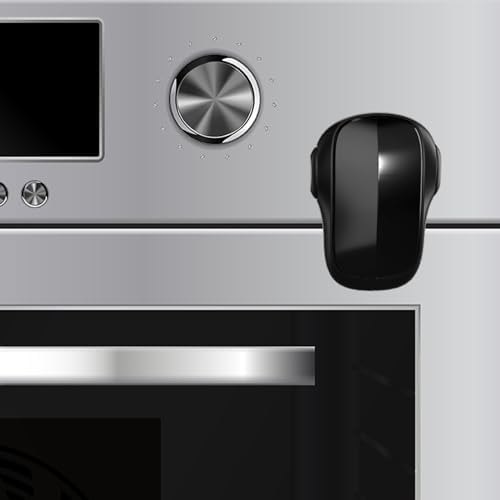
Adults open our black oven lock by pressing the double buttons and rotating the body 180 degrees. Full adhesive bonding takes 72 hours to reach optimum strength on the front panel. Keep in mind that when the oven is on, no mechanical latch replaces constant adult attention, as the exterior surfaces of the appliance still transfer heat.
Hidden interior latches mount completely inside drawers and cupboards, preserving the outward look of the room. Our invisible cabinet latches secure to the interior frame with adhesive, featuring an on/off switch to disable the mechanism when access is needed for extended cooking sessions. The extended catch arm accommodates countertops with standard front overhangs, requiring 30 seconds of firm pressure during setup and a 24-hour cure time for the tape.
External straps solve problems where internal clearance is blocked by drawer slides or shelving. Our flexible ABS strap latches adjust in length from 3 inches to 7 inches before mounting, allowing them to wrap around face frames, corners, and flat panels. Sliding the latch cover frees the catch, while pressing the circular platform re-engages it, offering a reliable exterior alternative where inside latches cannot reach.
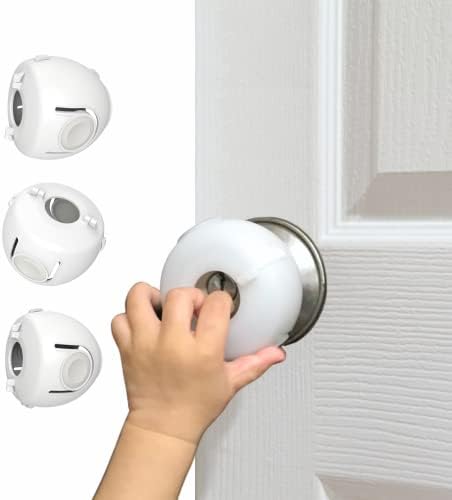
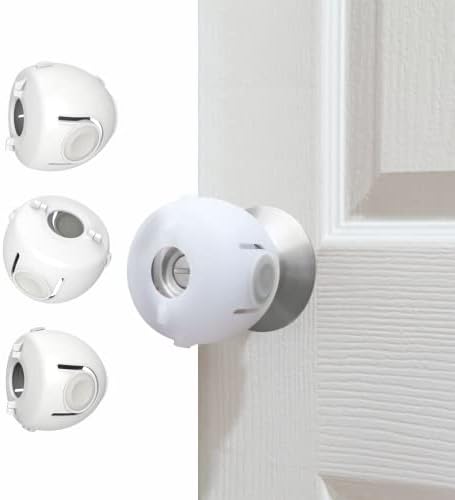
Standard round door knobs between 1.4 inches and 2 inches in diameter require a cover that encloses the entire handle. Our snap-together PP and TPR covers spin freely when gripped from the outside, preventing small hands from turning the spindle while allowing adults to pinch the dual side buttons. These covers do not fit oval, flat, or non-round hardware, and they are intended solely for interior doors.
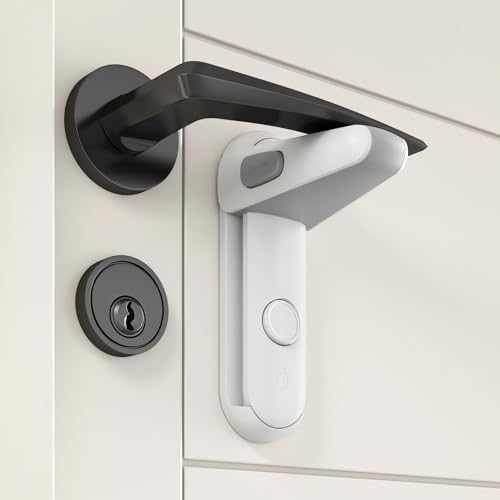
Lever handles bypass knob covers entirely and demand a base that physically blocks the downward travel of the arm. Our lever locks adhere directly to the door panel behind the handle, swinging left or right during adult use. Because some interior levers operate by pulling upward as well as down, doors with two-way handles require one lock above the lever and a second lock below it to fully obstruct the motion.
Childproofing hardware is designed to slow down a curious toddler and create a brief window of deterrence. It never creates an impenetrable barrier, and it never replaces active adult presence in the home. Toddlers observe adult routines closely and may eventually learn how specific buttons, slides, or latches operate through repeated trial and error.
Caregivers must inspect door hardware regularly to confirm that parts remain secure and adhesives stay firmly anchored. If a child manages to defeat a particular latch or cover, discontinue using that model immediately on that access point. Never install childproofing latches on exterior exit doors where rapid egress could be compromised during an emergency.
Start by measuring the physical dimensions of your knobs, handles, and appliance faces before ordering through our retail partners. Check that door knobs are round and fall within the 1.4-inch to 2-inch range, and verify that door panels have clear, flat space adjacent to lever handles without decorative trim in the way. On double doors and appliances, confirm that center gaps stay under 1 inch (2.5 cm).
Surface material also determines latch performance across the home. Clean, smooth, non-porous surfaces like painted wood, smooth metal, and finished plastics provide the best foundation for adhesive tape. Uneven or heavily textured surfaces will prevent uniform contact, reducing the bond strength needed to resist repeated pulling.